
UCAT Multiple Mini Interview (MMI) is a decisive moment for all medical students who want to prove their eligibility for the medical profession. In contrast to the conventional interviews, MMIs evaluate a broad range of skills in a set of timed stations, which include communication, ethics, empathy, problem-solving, and critical thinking. Although the training needed in an MMI might seem overwhelming with its distinctive format and variability, a systematic approach will help you to achieve a successful interview and stand out among other applicants.
This detailed blog now gives a more in-depth and engaging explanation of the MMI’s purpose, the candidate’s point of view, the changes to the format in 2025, and why a structured, early MMI interview preparation is necessary for success.
Understanding the MMI Format and Its Importance
The MMI consists of several short-term stations that expose candidates to various situations, questions, or role-plays, with pre-trained interviewers rating each individually. This methodology will ensure an equitable and unbiased evaluation within a range of competencies and reduce interviewer bias.
The task is not just to define what you know but also to evaluate your behaviour, attitude towards making decisions, and professionalism. Recent reports indicate that the face-to-face and online versions of MMI are now in widespread use, especially to accommodate the global candidates. The preparation of the two modalities will need flexibility and knowledge of the format of timed, scenario-based queries.
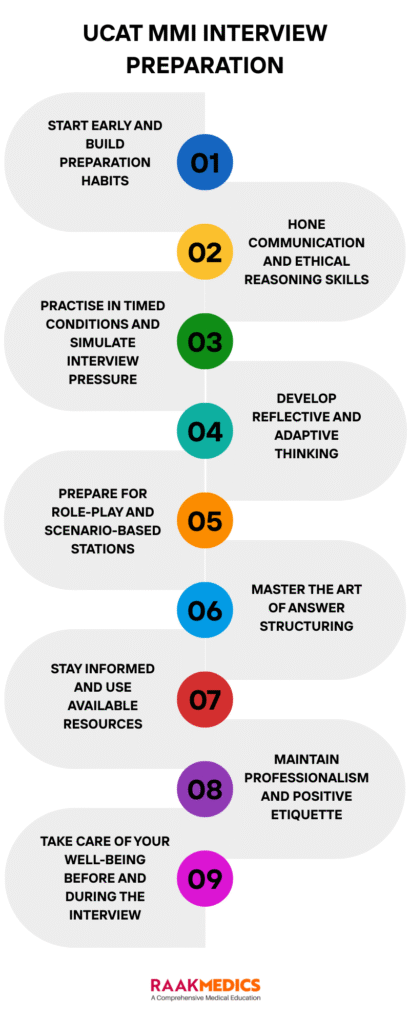
Step 1: Start Early and Build Preparation Habits
The MMI candidates who succeed understand the importance of early and methodical training. To begin your study about 2 months before an appointed interview will allow you to schedule your sessions and gradually build up skills. This practice will avoid burnout and allow gradual improvement in your ability to think on your feet. Even with a daily routine of 30-60 minutes, familiarising yourself with the format leads to mental fitness and reduces anxiety during the day.
Rather than cramming, establish a routine that includes practicing answer formats, reviewing ethical precepts, and practicing time stations. With constant practice, MMI interview preparation becomes a new habit and will make your answers much more natural than written down.
Step 2: Hone Communication and Ethical Reasoning Skills
The MMIs may also test your communication skills through the use of various stations, such as multifaceted ethical concerns, group work, and questions about your motivation. Your listening skills, articulation and demonstrated empathy are as important as what you say.
One of the most important parts of MMI interview preparation is to get acquainted with four fundamental pillars of medical ethics – autonomy, beneficence, non-maleficence, and justice – and understand how each of the pillars should be used in different situations. The ethical issues in most interview stations are unsolvable with a definite answer; thus, through a combination of moral justification and self-understanding, as well as respect for other opinions, it is possible to impress the assessors.
Step 3: Practise in Timed Conditions and Simulate Interview Pressure
One of the challenging aspects of the MMI is that it is timed. Stations typically last six to eight minutes, requiring you to articulate your thoughts quickly. It is important to learn how to organise answers in a short and limited time.
You should include timed practice in your preparation, in which you will recreate full MMI circuits or even particular stations with a focus on different types of questions, like role-plays, data interpretations, and ethical questions. These sessions can be video-recorded should body language, tone, and levels of confidence be monitored. Such practice is done through simulating the interview environment, which makes the future experience less stressful and more flexible and conditions the mind to respond to unpredictable questions with confidence.
Step 4: Develop Reflective and Adaptive Thinking
Reflection is required in the success of MMIs. Interviewers are interested in knowing how you think, how you make decisions, and what you learn by experience. Being reflective will increase your ability to analyse complex situations, take into account many points of view, and make decisions that are wise.
In practical terms, individuals should concentrate on justifying their decisions and reducing the severity of punishments. In addition, the transfer between stations is important to be done mentally, seeing each station as a new challenge to perform better and leave previous mistakes or difficult situations. One such attribute is flexibility, which indicates emotional stability and professionalism.
Step 5: Prepare for Role-Play and Scenario-Based Stations
The majority of MMIs include role-play stations, and you might have to engage with an actor who plays a patient, a colleague, or a family member. Active listening, empathy, clear communication, and professionalism are interpersonal skills that are essential to success in such stations. Simulate typical role-playing scenarios involving giving bad news, consent, and convictions.
Be attentive to non-verbal communication and have proper body language to enhance efficacy. Modern instructions highlight the importance of warming up the voice and face before the interview to enable effective and assertive communication.
Step 6: Master the Art of Answer Structuring
A coherent reply stands out in an MMI station. An effective response would generally include a brief background of the issue, a proper description of your course of action, a substantial explanation of your rationale or alternative solutions, and a brief conclusion that reflects a level of thoughtfulness.
Utilising a mental checklist aids in minimising word waste and ensures comprehensive coverage of the question’s details. Responses are placed in a rational and logical order as practice patterns like the STARR technique (Situation, Task, Action, Result, Reflection) order the responses sequentially.
Step 7: Stay Informed and Use Available Resources
The existing understanding of medical issues, policies of the NHS, and ethical discussions demonstrates the real interest in and devotion to the medical community. Reading recent news or seeing policy changes will make you ready to think intelligently in the stations discussing the latest issues or debating healthcare problems.
Many of these MMI interview preparation materials have offered related practice questions with step-by-step instructions and even artificial intelligence-generated feedback, which is both content- and presentation-based. By providing different question formats and performance reports, the use of these tools improves preparedness.
Step 8: Maintain Professionalism and Positive Etiquette
The main focus of creating a favourable impression is interview etiquette. Courtesy, punctuality, friendliness, and respect towards each person regardless of status are a representation of what is suitable in the healthcare setting. Be dressed professionally and in a proper way; body language must not be arrogant but confident, and eye contact and active listening must be upheld during the interview. Unobtrusive non-verbal cues have a strong impact on the perception of interviewers about interpersonal competence.
Step 9: Take Care of Your Well-being Before and During the Interview
It is the most important to determine the physical and mental requirements of the MMI. During the days that you are preparing for the interview, take time to rest, eat healthy, and learn relaxation techniques. Light facial and voice warm-ups on the interview day will help build confidence and reduce nervousness.
Go to the interview with the attitude of learning and developing, not with a fear of failure. Interviewers appreciate sincere and mindful responses and are eager to see you at the top.
Partnering with RAAKMEDICS for MMI Interview Success
You can be successful in your UCAT MMI interview with a deep, systematic preparation. However, professional advice can severely enhance confidence and willingness. At RAAKMEDICS, you can find comprehensive services for preparing for the MMI interview according to your personal needs.
By providing you with exposure to experienced mentors and simulated interviewing and personalised feedback, RAAKMEDICS empowers you with the skills required to shine at each station and increase self-efficacy.
Their comprehensive approach includes not only the use of interview techniques, but also emotional support and practical tips that will help one cope with this difficult process. Through collaboration with RAAKMEDICS, you are not just ready, but you will have everything needed to succeed in your UCAT MMI interview and can be mainstreamed towards your medical career dreams.
